
- The ‘Transfer Test’ of Khaki Integrity…
- Unyielding Courage, Uncompromising Sriram…
- A Chair for Compromise, a Transfer for Dharma — This Is Officer Sriram’s Journey
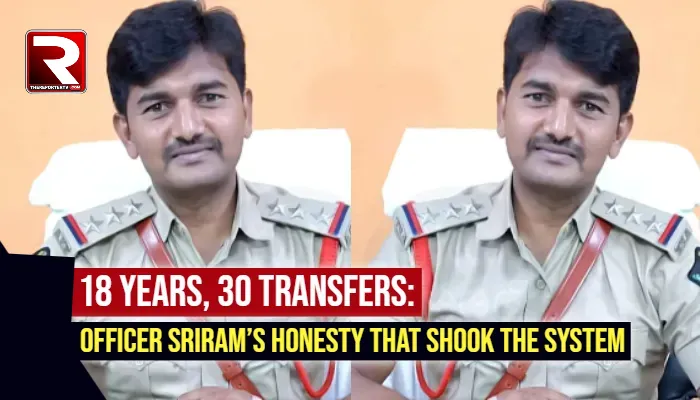
Andhrapradesh :In a system where silence is often rewarded and compliance guarantees comfort, Officer Sriram chose a far more difficult path — the path of truth. And the price he paid for that choice was steep: 30 transfers in 18 years of police service. Not because he failed the system, but because he refused to fail his conscience.
In Indian policing, transfers are routine. But when an officer is moved every few months — sometimes within just 40 days — it stops being routine and starts becoming a message. In Sriram’s case, that message was clear: stand your ground, and you will be moved.
A Career Built on Principles, Not Patronage
Sriram began his police journey in 2007 as a Sub-Inspector in Mudigubba. From day one, his approach was simple and uncompromising — the law applies equally to everyone. Political pressure, local influence, and power corridors had no space in his decision-making.
That very refusal to bend soon made him “inconvenient.”
While many officers cultivate political backing to secure long tenures, Sriram did the opposite. He cracked down on illegal activities, enforced the law without fear or favour, and refused to look the other way. Each such action quietly added another entry to his transfer file.
Kandukur. Puttaparthi. Rayadurgam. Proddatur.
The names of towns changed, but the story remained the same. Wherever he went, order followed. And soon after, so did the transfer.
The Hidden Cost of Transfers
A transfer is not just a change of station. It uproots lives.
For Sriram and his family, 30 transfers meant 30 fresh beginnings — new homes, new schools, new routines, and repeated emotional resets. Packing household goods again and again, living out of suitcases, celebrating festivals away from loved ones — these are sacrifices rarely mentioned in service records.
Yet, Sriram never complained. He believed that personal comfort is temporary, but professional integrity is permanent.
When Honesty Becomes an Offence
Ironically, Sriram’s biggest “fault” was that he did not learn the art of compromise. In a system where bending rules is often normalized, his strict adherence to law stood out — and not always in his favour.
There were postings where he barely settled in before orders arrived. Transferred. Again.
But what the system saw as punishment, the public began to see as proof.
A ‘Transfer Star’ in the Public Eye
Among citizens, Sriram earned an unusual title — the “Transfer Star.” Not because he sought attention, but because his frequent transfers spoke louder than any award. To many, they symbolised something rare: an officer who refused to kneel before power.
His story began circulating not as gossip, but as inspiration — especially among young officers who quietly struggle between career safety and moral courage.
Why Officers Like Sriram Matter
Democracy does not survive on laws alone. It survives on people who are willing to enforce those laws even when it costs them personally.
As long as officers like Sriram remain in the system, the common citizen’s faith in justice stays alive. Chairs may change. Postings may rotate. But integrity, once forged through sacrifice, does not weaken.
Still Standing
After 18 years, 30 transfers, countless disruptions, and relentless pressure, Officer Sriram remains what he always was — unbent, unbroken, and unafraid.
In a system that often tests how much an officer can compromise, Sriram’s life answers a far more important question:
What does it cost to remain honest — and is it worth it?
For him, the answer is clear.
Every single time.
As long as officers who refuse to bow before power exist in the system, the common citizen’s faith in justice will remain alive. Chairs may change, postings may change — but the resolve of real stars like Sriram never does.