
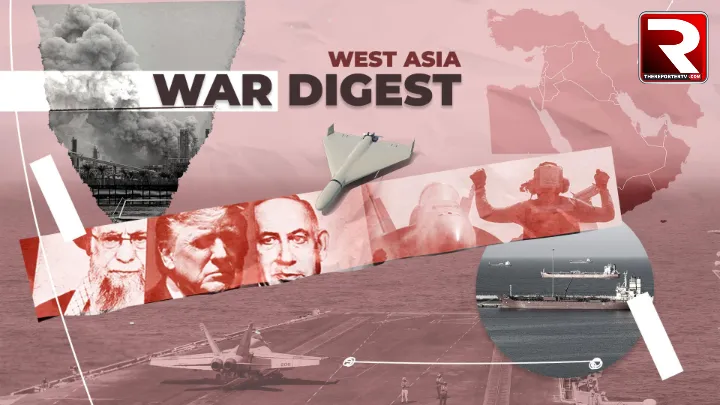
The conflict in West Asia has entered its 33rd day, with no signs of de-escalation as both sides continue to exchange intense military strikes. What began as a regional confrontation is now showing signs of expanding into a broader geopolitical crisis, drawing in global powers and raising concerns across international communities.
Despite growing calls for peace, the ground reality tells a different story. Reports suggest that U.S. President Donald Trump is open to ending the war, yet simultaneous military deployments by the United States in the region are contributing to heightened tensions. Iran, in response, has issued a strong warning, declaring its readiness to confront any escalation.
Airstrikes Intensify Across Iran
Major cities across Iran, including the capital Tehran, are witnessing relentless airstrikes carried out by Israeli and U.S. forces. Strategic targets such as military installations, missile systems, air defense units, and IRGC command centers have come under heavy bombardment.
A particularly controversial strike targeted the Tofigh Daru pharmaceutical facility in Tehran. Iranian authorities condemned the attack, stating that targeting a life-saving drug manufacturing center constitutes a violation of international law and could be classified as a war crime.
Iran’s Retaliation Expands Regionally
Iran has responded with a series of missile and drone attacks aimed at Israeli and U.S.-linked targets. In Tel Aviv, sirens echoed across the city as incoming projectiles triggered widespread alerts. Although many of the missiles were intercepted by defense systems, the psychological impact on civilians remains significant.
Elsewhere, in Baghdad, a drone strike targeted the U.S.-operated Victoria Airbase. Similar attacks were reported in Erbil, where U.S. assets came under fire, leaving plumes of thick black smoke rising over the area.
Civilian Impact and Religious Site Hit
In a tragic development, airstrikes in Iran’s Zanjan city struck a prominent Shia mosque, reducing parts of the structure to rubble. At least three civilians were killed after being trapped under debris. Emergency response teams rushed to the scene to carry out rescue operations, highlighting the growing humanitarian cost of the conflict.
Markets Show Resilience Despite Crisis
Interestingly, financial markets have shown unexpected resilience amid the geopolitical turmoil. Early trading saw major indices surge, with investor sentiment seemingly buoyed by expectations of a possible resolution or strategic stability in the near term.
Energy Crisis and Political Signals
Speaking at the Oval Office, Donald Trump addressed concerns over rising global oil and gas prices caused by the war. He suggested that energy markets would stabilize rapidly once U.S. military involvement in Iran winds down.
“We expect to complete our objectives within two weeks, or even sooner,” Trump stated, signaling a potential shift in U.S. strategy, though details remain unclear.
The Bigger Picture
As the war stretches into its fifth week, the stakes continue to rise—not just for the nations directly involved, but for the global economy and security landscape. With mounting civilian casualties, strategic strikes, and shifting political narratives, the question remains:
Is the region on the brink of a larger war, or nearing a fragile peace?
For now, the world watches closely as West Asia stands at a critical crossroads.