
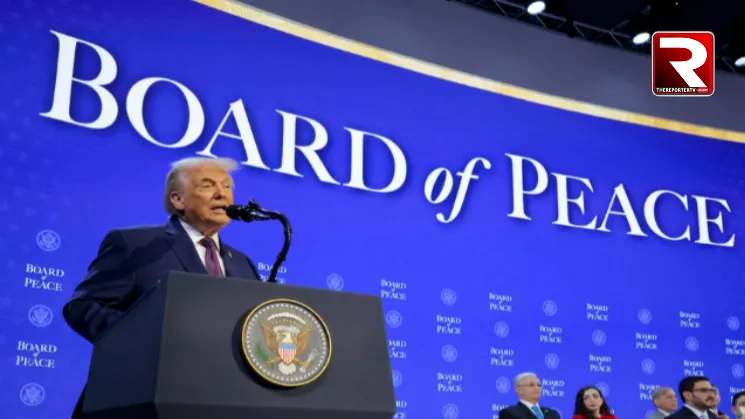
Washington: Donald Trump on Thursday gathered a select group of international allies in Washington to inaugurate the “Board of Peace,” a newly created institution aimed at advancing post-war stabilization efforts in Gaza, though officials suggest its mandate could expand to other global conflicts.
The meeting, held at the headquarters of the United States Institute of Peace, brought together around two dozen world leaders and senior officials. Notably absent were many traditional European democratic allies that have historically backed US-led initiatives. Instead, several leaders seen as ideologically aligned with Trump attended the event.
The “Board of Peace” initiative follows a ceasefire negotiated in October by the Trump administration in coordination with Qatar and Egypt, bringing a halt to two years of devastating conflict in Gaza. The truce came after the October 7, 2023 attack by Hamas on Israel, which triggered a large-scale Israeli military offensive.
US officials say the ceasefire has now entered its second phase, focusing on the disarmament of Hamas. According to Gaza’s health ministry, which operates under Hamas authorities, at least 601 people have been killed by Israeli forces since the truce began.
At Thursday’s meeting, Trump was expected to outline more than $5 billion in pledged assistance for Gaza’s reconstruction. Much of the territory remains in ruins, with widespread destruction of residential and public infrastructure. The summit also aims to establish an International Stabilization Force to ensure security in the enclave.
A significant participant in the initiative is Indonesia, the world’s largest Muslim-majority country. Indonesian President Prabowo Subianto has indicated readiness to deploy up to 8,000 troops if the stabilization force is formally approved.
US officials, including Trump’s envoy Steve Witkoff, have maintained that progress is being made in pressuring Hamas to disarm. Benjamin Netanyahu recently stressed that small arms such as AK-47 rifles must be confiscated as part of any credible disarmament effort. Israel’s government is represented at the meeting by its foreign minister.
Analysts caution, however, that dismantling Hamas’ military capacity will be complex. Jeremy Issacharoff of Reichman University said that for Israel, the viability of the initiative depends on whether a credible pathway to disarmament is established.
As part of tentative governance reforms in Gaza, a technocratic committee led by engineer and former official Ali Shaath was formed last month to oversee day-to-day administration. Hamas spokesman Hazem Qassem has urged the new board to press Israel to halt alleged violations and lift its longstanding blockade of Gaza.
The “Board of Peace” meeting comes amid controversy over its structure. Under terms outlined by the White House, Trump will retain veto authority over the body and may continue as its head even after leaving office. Countries seeking permanent membership beyond a two-year term would be required to contribute $1 billion.
Critics have questioned the broader ambitions of the initiative. Bruce Jones of the Brookings Institution described it as “a confused mix of ambition and narcissism,” arguing that it lacks intellectual coherence. The move also coincides with Trump’s scaling back of US engagement with the United Nations, including funding cuts and withdrawals from key bodies.
Among the leaders attending are Hungarian Prime Minister Viktor Orbán and Argentine President Javier Milei, both considered ideological allies of Trump. Pakistani Prime Minister Shehbaz Sharif is also participating, amid Islamabad’s efforts to strengthen ties with Washington.
However, major traditional US allies such as France and Canada are not represented. Japan has yet to commit to full membership and is sending a Gaza-focused envoy. Brazilian President Luiz Inácio Lula da Silva declined the invitation, saying the body should remain limited to Gaza and include Palestinian representation. Lula recently criticized the initiative as resembling “a new UN where only he is the owner.”
As the inaugural session unfolds, the “Board of Peace” signals a bold and controversial attempt by the Trump administration to reshape international conflict management — beginning with Gaza, but potentially extending far beyond.