
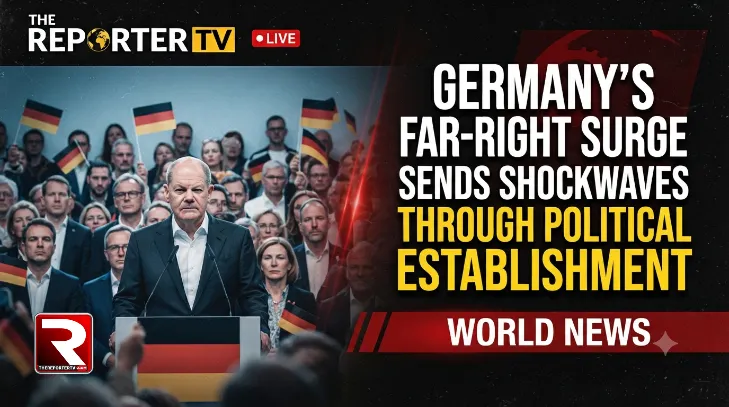
Berlin, September 12: Germany’s political establishment is facing a major new challenge after the far-right Alternative for Germany (AfD) made a historic breakthrough in the eastern state of Saxony-Anhalt, securing nearly 44% of the vote and leaving Chancellor Friedrich Merz’s government under growing pressure.
The AfD fell just three seats short of an outright majority in the state parliament. Its leading candidate, Ulrich Siegmund, is now seeking enough support from other parties to form a government — a development that could mark the first far-right state government in Germany since the Nazi era.
The election result has triggered deep concern among mainstream political parties and commentators, with many describing it as a turning point in German politics.
For Merz and his centre-right Christian Democratic Union (CDU), the result represents one of the party’s most serious electoral setbacks in decades. The chancellor himself acknowledged that something fundamental had changed, not only in Saxony-Anhalt but across Germany.
The pressure on Merz is expected to intensify as voters in two other German states head to the polls later this month. The outcome of those elections could further test his leadership and the stability of his government.
Merz Faces Growing Political Pressure
Merz, who has been in office for around 16 months, came to power promising to revive Germany’s struggling economy, strengthen national defence and reform the country’s social welfare system.
Political scientist Thomas Biebricher of Goethe University Frankfurt said one of the government’s biggest problems was its difficulty in explaining unpopular reforms to the public.
He argued that voters were being asked to accept difficult measures, including changes to pensions and healthcare, without being given a convincing explanation of how those sacrifices would lead to better conditions in the future.
Former Chancellor Angela Merkel, a longtime political rival of Merz within the CDU, has also criticised his approach to migration and his political messaging. However, she said she took no satisfaction from the CDU’s poor result because of the wider implications for Germany.
Merkel described the election as a “turning point” in the history of the Federal Republic of Germany and said the result was deeply painful for CDU members.
Speaking at a digital affairs conference, Merkel urged political leaders to recognise that emotions increasingly influence voters alongside economic statistics and other facts.
AfD Expands Beyond Migration
The AfD was founded in 2013 as a Eurosceptic party opposing financial assistance to debt-hit European countries. It subsequently moved further to the right, particularly during the 2015–16 refugee crisis, when more than a million asylum seekers arrived in Germany.
Migration remained one of the party’s central political issues, but the AfD has increasingly broadened its message.
The party has successfully tapped into concerns about deindustrialisation, rising living costs, crime, regional identity and the economic difficulties facing parts of eastern Germany.
Even as irregular migration into Germany has declined significantly since Merz took office, the AfD has continued to gain support, demonstrating that its electoral appeal now extends beyond immigration.
Germany’s Political ‘Firewall’ Under Strain
For years, Germany’s mainstream parties maintained a political “firewall” against the AfD, refusing to cooperate with the far-right party or allow it a role in government.
That strategy is now under increasing pressure.
The AfD has remained in opposition while using dissatisfaction with government performance to strengthen its appeal among voters. Its supporters have criticised the established parties for failing to deliver rapid improvements in living standards, economic growth and public services.
The breakthrough in Saxony-Anhalt has therefore created a difficult political situation for Germany’s mainstream parties. Whether the AfD can translate its electoral success into government power remains uncertain, but the result has already reshaped the political debate.
With crucial state elections approaching and major European elections scheduled for next year, Germany is entering a politically sensitive period that could have consequences far beyond Saxony-Anhalt.
Would you like a sharper headline and opening paragraph, or a more polished full rewrite in a human news style?