
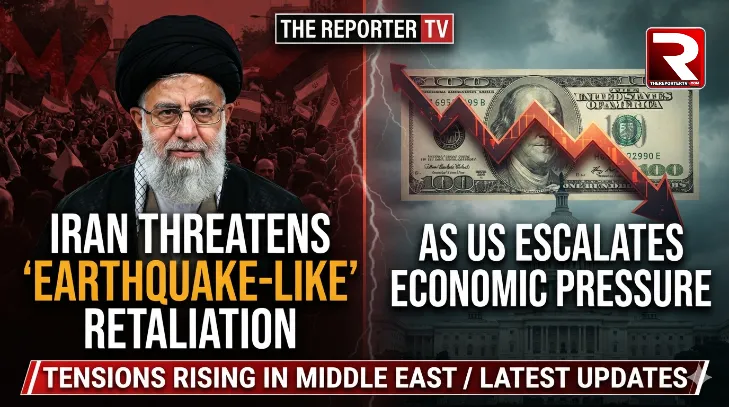
TEHRAN: Iran has warned that it will retaliate against any country that cooperates with the United States in imposing fresh sanctions on Tehran, raising fears of further disruption to oil supplies and shipping through the strategically vital Strait of Hormuz.
The warning came as the United States prepared what Treasury Secretary Scott Bessent described as one of the most aggressive financial campaigns ever directed against an adversary. Washington has said it intends to target countries and entities that continue trading with Iran through so-called secondary sanctions.
Iranian security chief Mohsen Rezaei issued a particularly strong warning to neighbouring Gulf states, saying Tehran would respond if they joined the US economic campaign.
“If the countries surrounding Iran join the Americans in their economic war, not a drop of oil will leave the Persian Gulf and the Strait of Hormuz,” Rezaei said. He also warned that Iran could target other oil-export routes from the Gulf.
UAE Move Raises Tensions
The United Arab Emirates, one of Iran’s most important trading partners in the region, announced an end to trade with Iran ahead of the expected US sanctions announcement. Tehran believes the move was coordinated with Washington.
The US administration is now seeking wider international compliance with its sanctions policy, putting countries such as India, China and Russia under pressure to reconsider their economic relations with Iran.
China, which has long been a major buyer of Iranian oil, has rejected unilateral sanctions imposed without a basis in international law. Chinese officials have previously instructed companies to disregard US restrictions on Iranian oil imports.
Beijing has also opposed the use of military pressure and economic sanctions as a solution to the dispute.
Iranian Oil Exports Hit
The confrontation comes as Iran’s oil exports to Asian markets have already been severely affected by the US naval blockade of Iranian ports. Iranian Central Bank Governor Abdolnaser Hemmati recently acknowledged that crude exports had virtually stopped.
The disruption has pushed the cost of Iranian oil cargoes higher and added pressure to international energy markets.
Iran’s currency has also come under renewed pressure. The rial was reported to be trading at nearly 1.992 million per US dollar on the unregulated market on Monday, marking a sharp decline since US President Donald Trump announced a new economic operation against Tehran.
Trump later declared on social media that Iran was “completely collapsing.”
Tehran Rejects US Claims
Iranian Foreign Minister Abbas Araghchi dismissed the expected sanctions as evidence of Washington’s desperation, arguing that similar pressure campaigns had failed in the past.
Iranian Foreign Ministry spokesperson Esmail Baghaei also accused Washington of targeting ordinary Iranians through sanctions.
He said forcing other countries to stop or restrict legitimate trade with Iran amounted to interference in national sovereignty and violated fundamental principles of international relations.
Iranian academic Hassan Ahmadian argued that Tehran has already lived under extensive US primary and secondary sanctions since 2018.
He said the latest US campaign represented a return to economic pressure after Washington and its allies failed to achieve their objectives through military action.
China and Russia Resist Pressure
Despite Washington’s warnings, China and Russia have so far shown little willingness to comply fully with the US campaign.
The key question now is whether major economies will consider continued trade with Iran worth the risk of US retaliation.
Washington has warned that countries refusing to comply could face financial and economic consequences. Bessent said the US would use its full economic power against governments and businesses that continue supporting Iran’s trade networks.
The US Treasury chief has argued that cutting Iran off from international finance could weaken Tehran without requiring further American military action.
Strait of Hormuz in Focus
The growing confrontation has also placed the Strait of Hormuz under renewed international scrutiny. Shipping through the waterway remained heavily disrupted over the weekend, adding further uncertainty to global oil markets.
Any prolonged closure or major disruption in the Strait of Hormuz could have significant consequences for international energy supplies because the waterway is a critical route for oil shipments from the Persian Gulf.
Meanwhile, Pakistan’s army chief, Field Marshal Syed Asim Munir, travelled to Tehran on Monday as Islamabad explored the possibility of reviving talks over a stalled memorandum of understanding involving Iran and the Strait of Hormuz.
With Washington threatening unprecedented financial pressure and Tehran warning of severe retaliation, the latest confrontation has raised concerns that an economic conflict could quickly spill over into a wider regional crisis.