
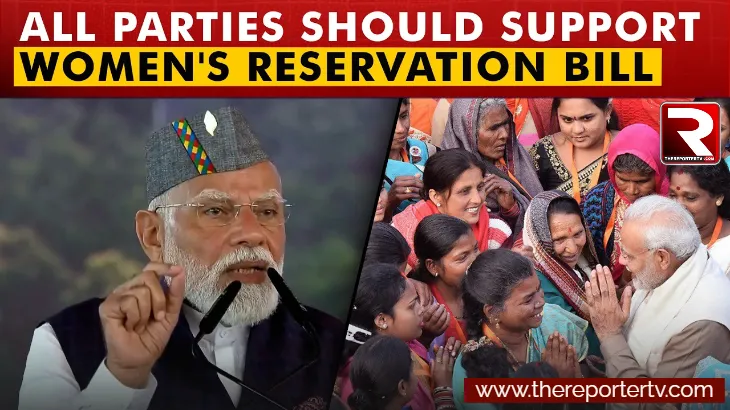
New Delhi: Prime Minister Narendra Modi on Thursday said that the ongoing debate around the Women’s Reservation Bill marks a historic moment in India’s parliamentary democracy, stressing that the measure should be seen beyond partisan politics and as a step toward empowering women in decision-making roles.
Speaking in the Lok Sabha, Lok Sabha, the Prime Minister said the Bill reflects a long-pending demand that has taken decades to reach this stage. He noted that while the idea has evolved over time and could still see refinements, its introduction represents what he called a “historic step” in India’s democratic journey.
Modi said there was a need for such a reform for nearly 25 to 30 years, adding that Parliament has the opportunity to “create history” through its passage. He described the moment as one of pride, saying India’s democratic system allows for such long-delayed ideas to eventually move forward through consensus.
Emphasising broader national unity, the Prime Minister said India was increasingly being recognised globally and that the idea of a “Viksit Bharat” (developed India) should not be limited to infrastructure or economic indicators alone. Instead, he said, true development must include the active participation of women—nearly half of the country’s population—in governance and decision-making.
“We feel that 50 per cent of the population should be part of decision-making. It has already been delayed,” he said, underlining that women’s representation in legislative spaces remains essential for balanced governance.
In a pointed message to the Opposition, Modi urged that the issue should not be politicised. He said that in earlier elections, women voters had responded strongly against those perceived to be opposing women-centric legislation, though he noted that the 2024 Lok Sabha elections did not follow that pattern as there was broad consensus on the issue.
He added that political consensus around the Bill should be viewed as a positive sign for Indian democracy, stating that neither the ruling party nor his government should seek credit for it once it is passed. “We do not want credit,” he said, suggesting that the focus should remain on institutional progress rather than political ownership.
The Prime Minister also highlighted the growing political awareness among women leaders emerging from grassroots governance structures, particularly in Panchayati Raj institutions. He said lakhs of elected women representatives at the local level are now more vocal in demanding inclusion in higher decision-making bodies, including state assemblies and Parliament.
Reflecting on his personal journey, Modi said his own background from a socially and economically modest community has shaped his commitment to inclusivity. He credited the Constitution for guiding his approach to governance and said he feels a responsibility to bring all sections of society along.
He further said that women across sectors are excelling and that the country has no shortage of capable female leaders. “Whenever women MPs have been given opportunities, they have enriched the House,” he said, adding that the passage of the Bill would recognise an existing reality rather than confer a favour.
Calling for a non-partisan approach, Modi urged lawmakers not to view the legislation through a narrow political lens. He said the reform represents a long-overdue opportunity and argued that delaying it further would be unjustified, asking rhetorically whether three decades had not been enough time to act.
Concluding his remarks, the Prime Minister said the decision would reflect India’s collective will and strength, from Kashmir to Kanyakumari, reinforcing that governance decisions should be unified and inclusive across regions and states.